
Integration should not take longer than innovation
Rigid system integration is slowing telecom innovation. This Catalyst uses agentic AI to replace static workflows with intelligent, dynamic orchestration.

Integration should not take longer than innovation
Commercial context
Telecom operators are expanding beyond connectivity into bundled offers such as fixed-mobile convergence, smart home services, streaming, and IoT. But launching those services still depends on complex integration across BSS, OSS, networks and third-party ecosystems.
In many environments, each new offer still requires manual API mapping, workflow configuration, and cross-domain testing across fragmented legacy platforms. That creates an ongoing integration tax: teams spend time maintaining brittle, tightly coupled connections instead of bringing new services to market.
The result is slower launches, higher operating costs, and less flexibility to respond to demand. In fast-moving areas such as digital lifestyle and smart home services, those delays can mean missed revenue and a poorer customer experience.
The solution
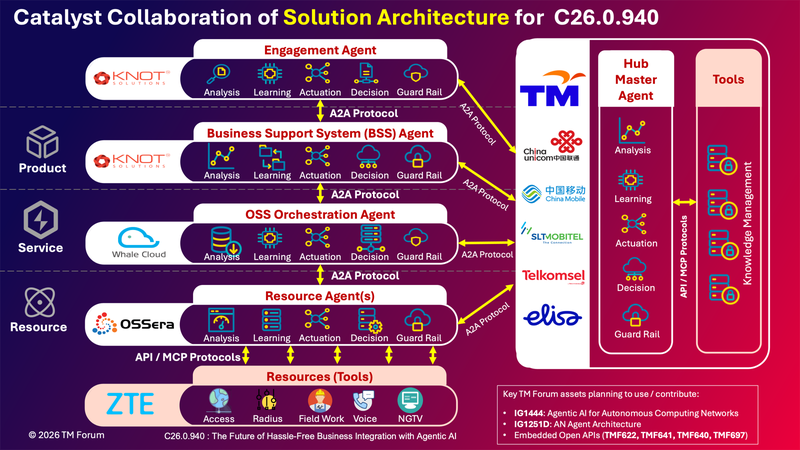
The Catalyst, The future of hassle-free business integration with agentic AI, introduces an agentic AI integration framework that uses AI agents and large language models to interpret service intent and orchestrate execution across multiple systems. Instead of relying on hard-coded workflows, the framework dynamically determines the actions needed to deliver a requested outcome.
For example, when a customer subscribes to a smart home or fixed-mobile convergence package, the agents can coordinate the required steps across product ordering, service ordering, billing, provisioning, network activation, streaming services and partner applications. The solution also includes specialist agents for customer engagement, BSS operations, OSS orchestration, resource management, and fault handling.
It is aligned with TM Forum’s Open Digital Architecture and Intent Framework and makes use of IG1444: Agentic AI for Autonomous Computing Networks, IG1251D: AN Agent Architecture, TMF641 Service Ordering Management, and TMF622 Product Ordering Management. Together, these assets support modular service onboarding, dynamic workflow generation, and self-healing operations, helping operators cut integration effort and speed up service activation.
Application and wider value
The expected impact is significant. According to the project team, the approach could reduce integration effort by 70–90%, shifting service launch timelines from months to minutes in the right conditions, while also lowering the operational burden of provisioning, orchestrationand assurance.
For operators, that means faster onboarding of new digital offers and more time for teams to focus on innovation rather than maintaining integrations. As Azni Risa, Vice President, Business Innovation & Technology at TM (Telekom Malaysia), puts it, “the value lies in tackling one of telecom’s most persistent problems: the complexity and cost of connecting fragmented BSS, OSS, network and partner environments while enabling a more seamless digital experience for customers.”
For the wider industry, the Catalyst shows how intent-driven, AI-orchestrated operations could reduce dependency on vendor-specific integrations and support more open, interoperable ecosystems. That is an important step toward autonomous operations at scale.
For customers and society, the benefits could include faster access to services such as connected home security, remote healthcare and energy optimization, alongside improved service reliability and more efficient use of infrastructure.

