Login
Register


Member Insights
Rakuten’s Mantu Kumar Tiwari looks at why it’s necessary to integrate ethics into organizational core operations rather than treating them as a secondary concern.
 Mantu Kumar Tiwari, Rakuten
Telecoms must focus on ethics when adopting new tech
As 5G matures and technologies like AI, internet of things (IoT), 6G and quantum computing converge, the decisions made by network operators regarding data integrity, equitable access and sustainability will have profound, global implications for the future of society.
Telecoms is no longer a background utility; it is the operating system of daily life, underpinning energy grids, transport, healthcare and emergency response. Billions of people depend daily on decisions telecom operators make about network design, data policy and service.
Each new technology generation arrives faster than the last, while AI increasingly automates decisions about who gets served and how. History offers a warning: While social media connected the world, it also amplifies misinformation and harms mental health, largely because ethical reflection has lagged deployment.
Telecoms must not repeat that pattern. The industry must put effective ethics at the core of planning to anticipate harms before they manifest, not remediate them afterward.
No single theory suffices. Utilitarianism weighs aggregate benefit against harm but can mask harm to minorities. Deontology grounds decisions in duties and rights, such as an unconditional duty to protect privacy, but offers limited guidance when duties conflict. Virtue ethics focuses on organizational character — honesty, courage to flag problems — cultivated through leadership example. Justice as fairness reframes connectivity as an entitlement rather than a market privilege.
The strongest governance integrates all four:
The table below summarizes the key challenges and solutions for each area.
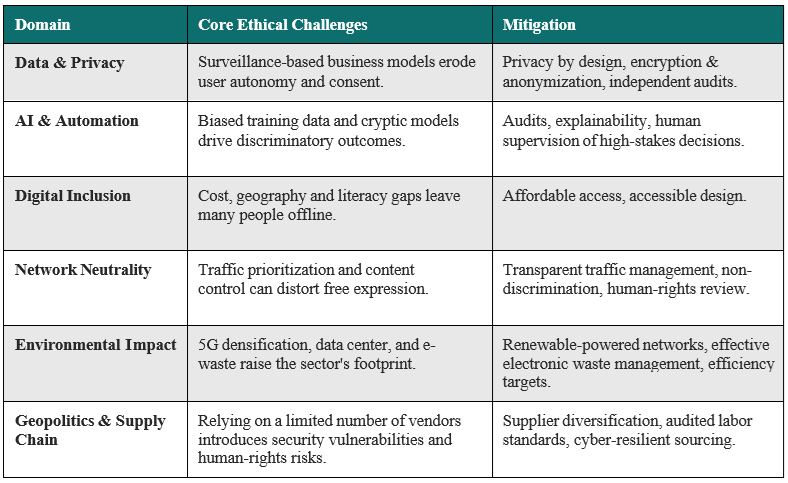
Regulation serves as a baseline, not a limit, especially as technological advancement frequently outpaces legislative capacity. Cultivating a genuine ethical culture requires more than aspirational statements; it demands actionable codes of conduct, robust whistleblower protections, meaningful community engagement and leadership willing to prioritize ethics over short-term gains.
By measuring ethical performance alongside financial results, organizations can transform values into auditable commitments. To navigate this, the industry must shift from reactive measures to “anticipatory ethics”, using tools like regulatory sandboxes, transparent frameworks and multi-stakeholder governance to address harms before they manifest.
To bridge the gap between principle and practice, telecommunications companies must transition from viewing ethics as a peripheral concern to embedding it directly into their core business strategies and performance metrics. Simultaneously, policymakers must move beyond rigid legislation to build adaptive, harmonized regulatory frameworks that can effectively keep pace with the rapid innovation cycles of 5G, 6G and AI.
Technologists play a critical role by prioritizing empathy and security-by-design, ensuring that systems are rigorously stress-tested for potential harms long before they reach the public. These technical and strategic efforts must be bolstered by civil society and academia, which act as essential watchdogs by conducting independent research into emerging digital risks.
Furthermore, these groups must lead public advocacy initiatives to foster a more resilient, digitally literate populace capable of navigating an increasingly complex technological landscape. Ultimately, this coordinated, multi-stakeholder collaboration is the only viable path to ensuring that future technological progress remains firmly aligned with human rights and collective societal well-being.
Telecommunications role in connecting humanity carries an ethical responsibility beyond commercial performance. Advancement of technology holds potential for human flourishing, but without sustained commitment to privacy, fairness, inclusion, sustainability and ethical governance, the same technology risks will deepen inequality and power concentration, and they will erode the public trust that connectivity ultimately depends on.
The telecoms industry holds the blueprints and the tools to determine whether that future is defined by unprecedented connection and opportunity, or by division and diminished trust. The path forward is to embed ethics into strategy now, treating every stakeholder as a partner, before deployment.