Reinventing IT for the AI era
In an extract from our upcoming Benchmark report Chief Analyst, Mark Newman, sets the scene for how communications service providers (CSPs) are rethinking and reinventing their IT in the face of the onward march of AI.
 Mark Newman, TM Forum
Sponsored by:


Reinventing IT for the AI era
IT organizations within communications service providers (CSPs) have been striving to reinvent themselves for the past 15 years or more. That is how long operators have been pursuing digital transformation – a strategy for the whole business, but one which falls most squarely on the IT organization.
To date, operators have had limited success with their digital transformation initiatives. Indeed, some in the telecoms industry would say that digital transformation in general has failed. If we are to measure the success of these projects based on three key metrics – efficiency gains, new revenues, customer experience improvements – evidence of significant progress is scarce.
Research consistently points to a lack of success: McKinsey, for example, estimates that 70% of digital transformation initiatives fail to meet their objectives. But what do the executives at the heart of these transformations think? And how do they see the future of transformation projects?
During December 2025 and January 2026 we surveyed 216 IT executives from 111 operators in 72 countries about the status of their digital and AI transformation journeys. There was excellent participation from IT leaders, with 33 respondents identifying themselves as C-suite. The survey also garnered responses from practitioners both in network architecture and in software engineering roles.
The full demographics are shown in the upcoming report.
Reassessing the business drivers for transformation
In our survey we asked respondents to rank four strategic objectives of digital transformation: efficiency gains, new revenues and customer experience improvements, as already singled out above, plus speed and agility. The number one objective – by a clear margin – was improved customer experience, followed by speed and agility. Delivering new revenues and cost savings ranked some way behind the other two business goals (see graphic).
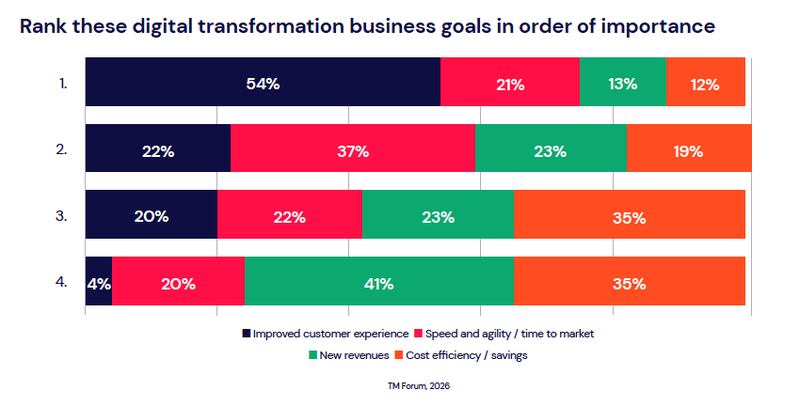
IT “reinvention” has emerged as a focus and strategy largely because of the new capabilities enabled by AI. Agentic AI, in particular, opens up the potential to address some of the roadblocks that CSPs have encountered on their transformation journeys, driving as it does greater automation in networks. It may also allow IT organizations to push those transformations much farther and faster than was previously possible. Indeed, based on our conversations with many CSPs the number one driver for AI transformation is speed and agility rather than customer experience.
Seven reasons why IT reinvention is essential
We have identified seven key reasons why reinvention of the IT function and organization is important for CSPs.
- Digital transformation is incomplete and AI can address the remaining obstacles
A central pillar to IT transformation – within the overall context of digital transformation – is migration away from closed systems that are maintained and customized by vendors towards a simplified architecture that makes it (relatively) straightforward to modernize, upgrade and to swap in and swap out different vendors’ IT components. While many operators have had some success transitioning to open architectures and API-based systems in customer-facing functions, core IT systems generally have not been upgraded for 20 years or more and continue to require expensive customization and maintenance.
But the emergence of agentic AI, and its use across the software development lifecycle, opens up the possibility of CSPs being able to transition away from these legacy systems.
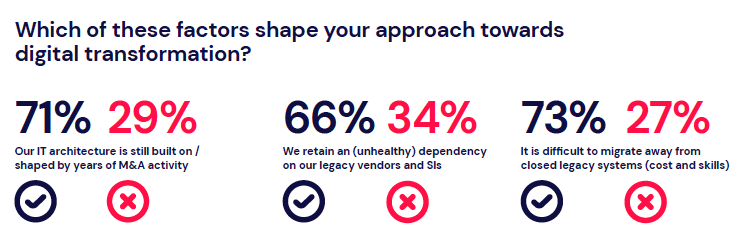
The reality of vendor lock-in came out strongly in our survey, with two-thirds of respondents agreeing that they retain an unhealthy dependence on their legacy vendors and systems integrators and three-quarters recognizing the challenge of migrating away from legacy systems (see graphic below). The fact that many operators have either acquired, or been acquired by, other CSPs, and have had to stitch together two or more sets of IT systems, is another reason why transformation has been so difficult.
The other key reasons we have pinpointed for IT reinvention, detailed in the report, are:
- AI is bridging the gap between the IT organization and the business
- The customer experience remains poor
- Business agility is still needed (and is lacking)
- CSPs need to move faster to capture AI innovation
- Sovereignty and cyber issues are changing the rules of the game
- The roles and skills requirements of the IT organization are changing.
Join our webinar ahead of the published report to find out more on this topic from our sponsors, then read the full report in May to learn:
- Why IT needs to be reinvented in order to fully embrace AI and deliver new services
- The business context that underpins the need for CSPs to reinvent IT
- Where operators are in their digital transformation projects
- How software engineering and architectures are changing in the face of the onward march of AI
- The evolving relationships between CSPs and their technology partners.