Orange Business aims to harness transformation to deliver innovative enterprise services
 Joanne Taaffe, TM Forum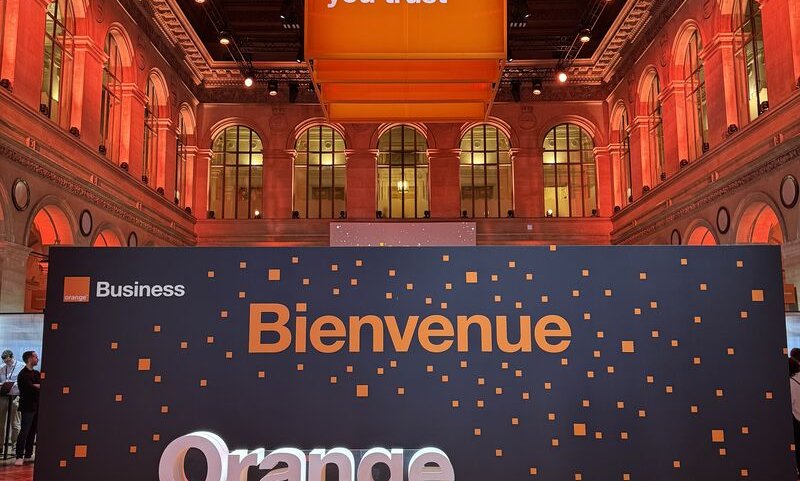
Orange Business aims to harness transformation to deliver innovative enterprise services
Orange Business is partnering with Tech Mahindra to both accelerate its own IT transformation and go to market with services. The move reflects an urgency within Orange Business to meet new customer demands amid an uncertain and fast-changing geopolitical and technological environment.
“We should really help customers to be … prepared for the unforeseen,” said Usman Javaid, Chief Product and Marketing Officer, Orange Business, in an interview with journalists on the sidelines of an Orange Business event in Paris earlier this month for approximately 1,000 enterprise customers.
At the same time, the company has been automating its own systems to ensure it can compete on price.
“We absolutely need to make sure that our service costs are aligned to the market,” said Rob Willcock, CEO, Orange Business International. The competitive landscape has shifted recently as the operator faces more direct challenges from large Indian systems integrators, including at times Tech Mahindra, than from telcos such as AT&T or BT.
“Still coming under heavy competition, price wise, from the way the service is delivered, because some of the big Indian players are ahead on the automation game," said Willcock. This, he explained, "is one of the reasons we hit the strategic alliance with Tech Mahindra to go faster,” on transformation, said Willcock. “We firmly believe that Tech Mahindra can accelerate that in the next 12 to 18 months.”
Jointly addressing customers is a significant component of the deal, said Rob, including in North America, where Tech Mahindra is strongly placed. “Going together with them in the future is one of our big hopes for expanding both in Europe and in the North American region,” he said.
What a difference three years makes
The partnership is the latest stage in a deep-seated transformation that started three years ago in response to changing enterprise requirements.
“Customers were expecting us to offer much more digital, fully automated experiences. And to be very honest, we were not ready for all that three years ago,” said Javaid. “So, this is where we started this massive transformation.”
Since then, the company has built a completely new, centralized operating model and ramped up the automation and digitalization of its IT systems and tooling. And it has invested heavily in reskilling its teams for future service delivery.
“Fast forward three years, we already see the fruits of that transformation,” said Javaid.
One of the operator’s bets for growth is its connectivity-as-a-service platform (which can also be thought of as a network-as-a-service platform), called Evolution Platform. This allows enterprise customers to compose and deploy connectivity, cybersecurity and cloud services on demand. At the same time, Orange Business has worked to halve its product portfolio.
“In the last half of the year, we saw a 60% increase in the customer base on Evolution,” said Javaid. In total, 427 customers signed on to the new platform in 2025, according to Orange’s financial results for the year.
However, revenue loss remains a challenge for the enterprise unit, as customers continue to move away from legacy products such as MPLS. Orange Business’ revenues fell 4.8% to reach 7.325 billion euros (USD$8.5 billion) in 2025.
In infrastructure we trust
As a company, Orange focuses its brand and customer proposition around the concept of trust. Javaid believes end-to-end infrastructure ownership is Orange Business’ biggest strength when it comes to instilling trust
“Once you own the infrastructure, you know where the data is, where you can access the rights to users to use [data] in a certain place,” said Javaid, noting that the definition of infrastructure is expanding to cover network, cloud and AI infrastructure.
Cybersecurity also ties in neatly to the trust proposition, and it’s a service area in which Orange Business grew revenues more than 7% in 2025. A related customer demand in a tense geopolitical environment is data sovereignty – specifically, the management and operation of geographically defined IT stacks that meet different regional sovereignty requirements.
“Sovereignty is coming in again and again; there is security, security, security,” said Javaid. “And of course, underlying all of that … more customers are going back to understand that your network is absolutely fundamental in terms of design, flexibility, capability, trust.”
AI voice is the new black
Orange Business made the most of its customer event to launch several new products that demonstrate how it can help enterprises benefit from AI while also protecting themselves from its risks.
For example, Orange Business is using AI to make service management and ticketing more efficient within contact centers, and it has demonstrated agentic AI-powered cloud telephony, which is designed to manage and deliver a smoother customer experience.
“Voice is one of the use cases for AI that’s really making a real difference,” said Javaid.
The company has also launched trusted caller branding, which allows enterprises to authenticate voice services with a name, logo and reason for calling. And it is partnering with companies including Sensity and Reality Defender to provide deepfake detection on corporate communication platforms such as Teams. These pick out fake audio, video, images and communications used by fraudsters and identify imposters joining calls using “face-wrap” technology.
Other AI tools include Live intelligence Studio, which is a platform to help enterprises develop and deploy their own AI agents.
“It’s very easy to build an agent as a POC [proof of concept]. It’s very, very hard to put that into production,” said Javaid. “And this is where our advisory services are going to help.”
Here again, Javaid emphasizes the importance of a trusted infrastructure. “You build your agents with the models you choose, and they are hosted on our sovereign cloud platform, so your data never leaves,” a specific country or region, he explained.
He also describes the opensource nature of the platform as critical “because if you build an agent on Live Intelligence Studio, you can port that agent to Microsoft, Azure or AWS.”
Sovereignty is an important element of another new offering, called Orange Drone Guardian, which provides drone detection-as-a-service to organizations that need to protect critical physical infrastructure or events from drone activity.
Orange Business can install drone detection sensors on any of the 20,000 cell sites in France that belong to Orange’s tower infrastructure arm, TOTEM. A security operations center (SOC) based in France processes and analyzes data captured by the sensors in real-time, on a private cloud platform, and alerts enterprises to any drone activity. Orange Business is looking to extend the service beyond France, making use of Totem’s assets in Spain, for example, where it operates 7,400 towers.
This combination of managed physical infrastructure, AI and data analysis, security and data sovereignty to provide a solution as-a-service encapsulates where Orange Business is targeting growth.
“The differentiation, for me is that once you have this core that [customers] trust and believe in … what they're wanting is the breadth of innovation we can do, whether it's IoT … whether it's the contact center, whether it's AI,” said Willcock. “They are coming to us, because they trust us and they believe that we have the capabilities in all of these different areas. And I think that's where the continued growth is.”