Intent‑based IT: the interconnected future of telco operations
A recent report and webinar explore how intent‑based operations, modern OSS/BSS and AI are reshaping telco operations, and what CSPs must modernize to unlock automation and enterprise growth.
 Richard Webb, TM Forum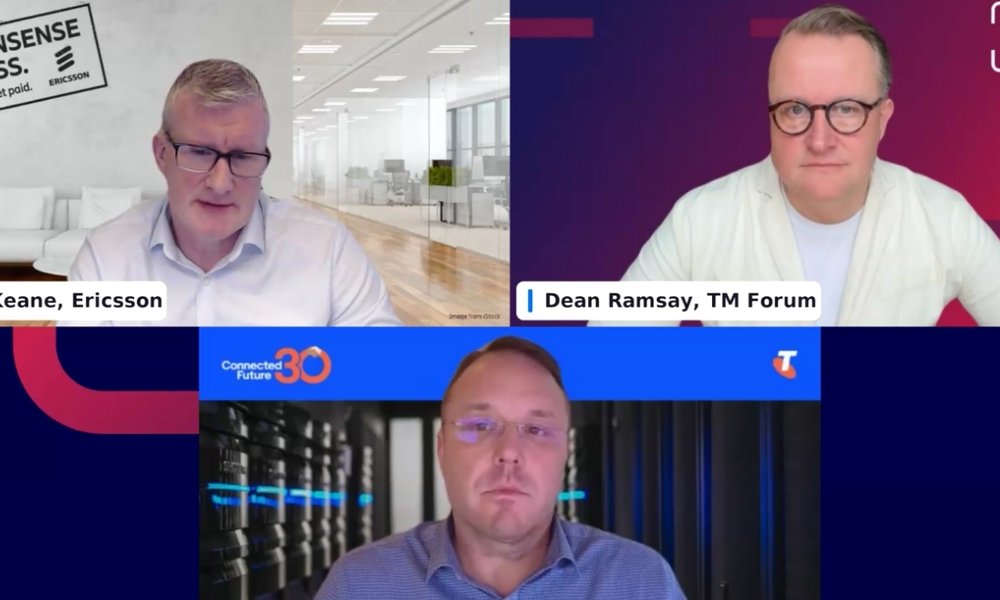
Sponsored by:

Intent‑based IT: the interconnected future of telco operations
For more than a decade, communications service providers (CSPs) have invested heavily in network upgrades, digital transformation programs, and new service capabilities. How telcos’ realize value from their networks, however, has not progressed apace, and is now a renewed focus of attention.
Whilst past transformation efforts focused on network modernization and upgrades of siloed IT systems, the industry is now shifting decisively toward service‑layer intelligence, automation, and operational cohesion. This recognizes that the bottleneck to end‑to‑end automation and differentiated connectivity is not just in the network but also in OSS/BSS stacks, which often remain fragmented, bespoke, and poorly integrated. These challenges prevent CSPs from achieving the agility and automation required for monetizing next‑generation network services.
Intent‑based operations represent a redefinition of how CSPs deliver services. Instead of configuring networks manually or through predefined scripts, customers or operators express a desired business outcome—such as a latency threshold, availability objective, security level or performance guarantee—and intelligent IT and network systems translate that intent into policies, configurations, and real‑time actions. This transformation is made possible through AI, automation, unified data, and standardized intent models.
Although components of intent are emerging through proofs of concept and pilot deployments, the report, which includes data from a survey of 110 individuals in 72 CSPs across 50 countries, shows that many of the foundational capabilities—clean data, cross‑domain orchestration, accurate inventory, real‑time assurance, and aligned IT‑network control loops—remain immature or inconsistently applied (see graphic below).
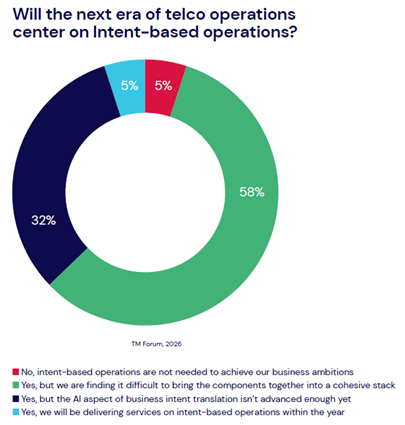
IT modernization is a vital prerequisite for IBO. CSPs must upgrade and unify OSS/BSS capabilities across product catalog, ordering, orchestration, charging, assurance, and inventory to enable seamless automated workflows. Today, these systems often operate in silos, blocking closed‑loop automation and causing errors, delays, and redundant processes.
Cloud‑native architectures play a key role. Modernizing IT to microservice‑based, containerized, API‑driven components not only accelerates delivery but enables real‑time responsiveness, elasticity, and interoperability—qualities essential for intent‑driven automation. The report emphasizes alignment with the TM Forum’s Open Digital Architecture (ODA), which provides standardized software components, designs, and APIs that help CSPs break free from monolithic IT systems.
Having a unified data strategy is another decisive success factor. Nearly all survey respondents acknowledge that data fragmentation is the main barrier preventing automation and AI from achieving real impact. Legacy data models, inconsistent inventory records, and unreliable telemetry disrupt closed‑loop operations and break intent translation. The report calls for a single, governed data fabric—capable of supporting near‑real‑time analytics, AI workflows, and cross‑domain orchestration.
AI is both an enabler and a catalyst, but it does not provide a shortcut around structural problems. While generative AI and agentic systems have already shown value in CRM, customer care, and other IT workflows, AI delivers exponential benefits only after the underlying operational architecture has been simplified and modernized. Agentic AI—multi‑agent systems capable of interpreting intents, making decisions, and executing actions—will increasingly power service operations, though human governance remains essential.
One of the central challenges outlined in the report is bridging long‑standing gaps between IT systems and the network domains they are meant to control. Some BSS and OSS applications were never designed for real‑time interaction with the network, yet intent‑based operations require continuous feedback loops between customer‑level intents and the state of resources across RAN, transport, and core. Legacy inventories, siloed assurance systems, and inconsistent data models disrupt these loops. This underscores the need for service orchestration that spans IT and network domains, unifying them into a cohesive operational fabric.
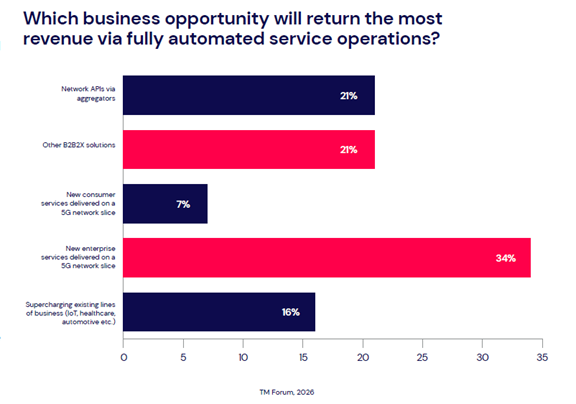
Revenue growth remains a key driver of telecom transformation, and the report is explicit about where these opportunities lie. CSPs identify enterprise and B2B2X models—particularly those relying on differentiated connectivity, slicing, and network APIs—as the most promising avenues for growth (see graphic below). CSPs that fail to implement intent‑based operations risk repeating the 3G/4G pattern of heavy infrastructure investment with limited monetization. Intent‑ready OSS/BSS capabilities—including SLA‑aware charging, partner settlement, and API exposure—are essential for capturing value in next‑generation enterprise ecosystems.
The report concludes with seven actionable recommendations for CSPs, forming a structured roadmap for transitioning from today’s fragmented operations to fully intelligent, intent‑driven ecosystems:
- modernizing OSS/BSS
- adopting unified data strategies
- embracing cloud‑native architectures
- embedding AI and agentic systems into workflows
- deploying end‑to‑end orchestration
- prioritizing closed‑loop automation
- developing monetization strategies for APIs and slicing.
The future of telco operations is intent‑driven, automated, data‑led, and IT‑centric. Networks will remain essential, but value creation will increasingly be determined by the intelligence and agility of the systems that sit above them. Operators that modernize their IT foundations, unify their data, and embrace AI‑native, cloud‑native architectures will be positioned not only to automate but to differentiate—and to thrive in a B2B2X‑driven digital economy.
The report is free to download and can be found here:
IT with intent: the interconnected future of telco operations
To learn more about how Australian telco Telstra is transitioning to intent-based operations listen to a webinar with Chief Architect Mark Sanders here:
The future of telco IT operating models: the road to intent-based operations