Member Insights
AI autonomy governance (a governance framework for agentic AI ): enabling safe, accountable, and scalable autonomous intelligence
Sukrit Kalia, Subject Matter Expert — Artificial Intelligence & Machine Learning at Omantel looks at how agentic AI enables autonomous enterprise work while creating new governance, security and accountability risks that require structured oversight, safeguards, and human responsibility.
 Sukrit Kalia, Omantel
AI autonomy governance (a governance framework for agentic AI ): enabling safe, accountable, and scalable autonomous intelligence
Abstract
Agentic Artificial Intelligence represents a fundamental shift from assistive AI toward autonomous digital actors capable of planning, reasoning, and executing complex enterprise tasks. While these systems promise transformative gains in productivity and operational efficiency, they introduce new governance, security, and accountability challenges.
This whitepaper presents a structured governance framework designed to enable organizations to safely deploy and scale AI agents. It outlines governance principles, risk categories, operational controls, and lifecycle management practices required to ensure responsible adoption of agentic AI within enterprise environments.
1. Introduction: The Rise of Agentic AI
Artificial intelligence is evolving beyond content generation toward autonomous execution. AI agents are now capable of interpreting objectives, coordinating workflows, interacting with enterprise systems, and taking actions on behalf of humans.
Unlike traditional automation or generative AI tools, agentic systems operate with:
- Multi-step reasoning capabilities
- Dynamic decision-making
- Tool and API integration
- Inter-agent collaboration
- Continuous environmental adaptation
These capabilities position agentic AI as a strategic enterprise asset across telecommunications, customer operations, software engineering, and digital transformation initiatives.
However, autonomy fundamentally changes risk exposure. Agents may access sensitive data, initiate transactions, or influence operational outcomes without continuous human supervision. Governance models must therefore evolve from model governance to autonomy governance.
2. Scope and Applicability
This framework applies to:
- Internally developed and third-party AI agents
- All lifecycle environments: development, testing, and production
- Employees, vendors, and partners involved in agent deployment
- Systems capable of autonomous planning or execution
The framework supplements existing enterprise policies relating to information security, data privacy, risk management, and software engineering governance.
3. Understanding Agentic AI
Agentic AI refers to autonomous systems that pursue defined objectives through coordinated reasoning and action. An AI agent can:
- Break complex goals into executable tasks
- Select and use digital tools
- Interact with enterprise applications
- Learn from feedback and adapt behaviour
The defining feature is action autonomy — moving from answering questions to performing work.
4. Governance Pillars for Agentic AI
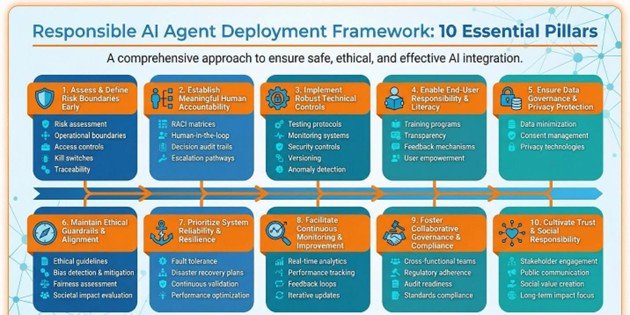
Effective governance requires a multidimensional approach integrating organizational, technical, and ethical controls.
4.1 Risk Boundaries
Organizations must define approved operational limits for agents. Risk classification should determine autonomy levels, data access permissions, and approval requirements.
4.2 Human Accountability
Each agent must have designated business and technical owners. Humans retain ultimate responsibility and must be able to supervise, intervene, or override decisions.
4.3 Technical Safeguards
Agents should operate under least-privilege access, secure authentication, activity logging, and constrained execution environments.
4.4 User Literacy
Responsible adoption depends on informed users. Training must cover agent limitations, safe usage, and decision accountability.
4.5 Data Governance
Agent data usage must comply with classification, privacy, retention, and monitoring standards.
4.6 Transparency and Auditability
Users must be informed when interacting with AI agents. Systems should maintain traceable logs supporting audit and investigation.
4.7 Continuous Monitoring
Lifecycle oversight must detect performance drift, anomalous behavior, and emerging risks.
4.8 Ethical Design
Bias evaluation, fairness testing, and societal impact considerations must be integrated into solution approval processes.
4.9 Regulatory Compliance
Organizations must demonstrate governance readiness through documentation, impact assessments, and regulatory alignment.
4.10 Organizational Culture
Responsible AI adoption requires leadership commitment, cross-functional collaboration, and proactive risk reporting.
5. Risk Landscape of Agentic AI
While agentic AI inherits traditional software and AI risks, autonomy amplifies their impact.
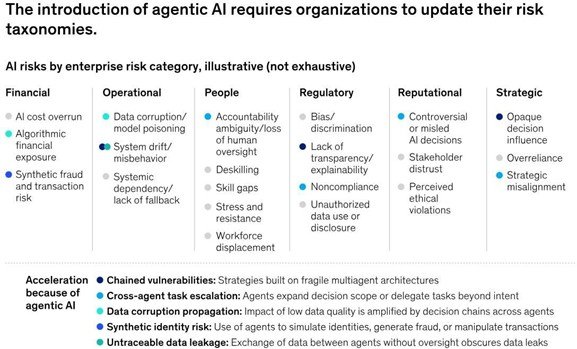
Source: McKinsey
Key Risk Drivers
- Autonomous planning errors cascading across workflows
- Incorrect tool or API usage
- Prompt injection and adversarial manipulation
- Agent-to-agent communication vulnerabilities
- Emergent system behavior
Risk Categories
- Operational execution failures
- Unauthorized actions
- Bias and unfair outcomes
- Data exposure or misuse
- Enterprise-wide system disruption
Risk management must therefore focus not only on model accuracy but also on behavioral control.
Factors Affecting Risk and Impact
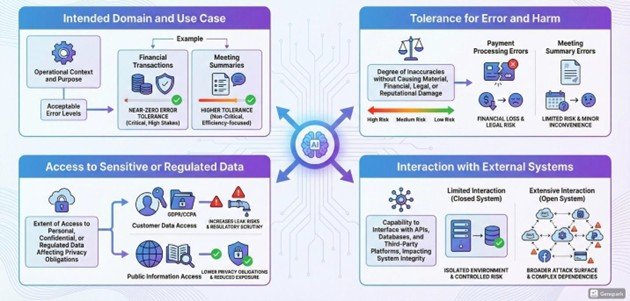
6. Designing Safe Agents
Risk mitigation begins during system design.
Organizations should implement:
- Minimum necessary system and tool access
- Defined autonomy boundaries
- Sandbox environments for high-risk tasks
- Shutdown and containment procedures
Agent Identity and Access Governance
Every agent should possess a verifiable digital identity enabling authentication, authorization, and traceability. Agent permissions must never exceed those of supervising humans.
7. Meaningful Human Accountability
Maintaining oversight becomes complex as agents adapt dynamically and multiple stakeholders contribute across the lifecycle.
Key governance practices include:
- Clear accountability mapping across design, deployment, and operations
- Mandatory human checkpoints for high-impact decisions
- Regular audits of oversight effectiveness
- Hybrid monitoring combining automation and human judgment
Third-Party Agent Governance
Organizations remain accountable even when deploying vendor-provided agents. Contracts must address security controls, auditability, and operational transparency.
8. Agentic Guardrails and Operational Controls
Autonomous systems require structured intervention mechanisms.
Essential Guardrails
- Human approval for irreversible or legally binding actions
- Detection of anomalous or out-of-scope behavior
- Configurable human-in-the-loop controls
- Oversight interfaces designed for rapid decision-making
To prevent automation bias, organizations should complement human review with real-time monitoring and independent supervisory agents.
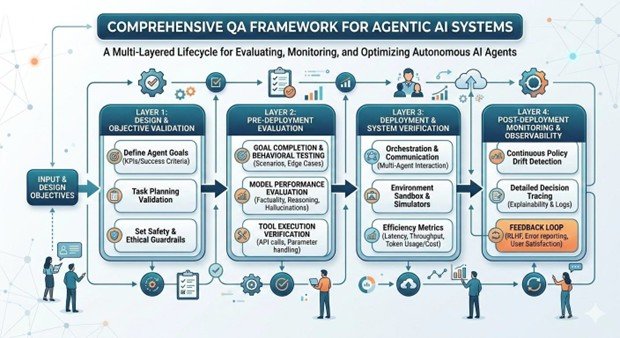
9. Agentic Quality Assurance
Traditional AI testing focuses on outputs; agentic QA evaluates behavior.
Four Pillars of Agent Testing
- Execution — task completion accuracy
- Compliance — adherence to policies and permissions
- Integration — correct system interaction
- Resilience — safe recovery from failures
Recommended practices include:
- Reasoning trace analysis
- Multi-agent red teaming
- High-fidelity sandbox testing
- Automated evaluation using monitoring agents
Following diagram illustrates the recommended framework for Quality Assurance best practices for Agentic AI Systems
10. Deployment and Continuous Observability
Agent deployment should follow progressive rollout strategies:
- Canary releases to controlled user groups
- Restricted operational scope during early deployment
- Real-time telemetry capturing decisions and actions
- Automated alerts triggering human intervention
- Emergency kill-switch and fallback mechanisms
Continuous monitoring must prioritize high-risk actions such as financial operations, data modification, and privileged access.
Post-deployment validation is essential to detect performance drift and silent failures.
11. Building Trust Through User Accountability
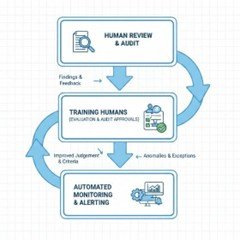
End users play a critical role in safe agent operations.
Organizations should ensure:
- Clear disclosure when users interact with AI agents
- Transparency regarding agent capabilities and authority
- Defined escalation pathways to human supervisors
- Training on AI failure modes and verification practices
- Preservation of human expertise to prevent skill degradation
Trust in agentic AI depends on transparency, education, and shared responsibility between humans and machines
12. Conclusion
Agentic AI marks a transition from intelligent tools to autonomous digital workforce systems. While the technology enables unprecedented productivity gains, it also introduces new dimensions of operational, ethical, and governance risk.
Organizations that succeed will be those that embed governance directly into the agent lifecycle combining human accountability, technical safeguards, ethical design, and continuous monitoring.
Responsible adoption is not achieved through restriction but through structured enablement. With the right governance foundations, enterprises can safely scale agentic AI while maintaining trust, resilience, and regulatory confidence.
References
1. https://aws.amazon.com/blogs/security/the-agentic-ai-security-https://aws.amazon.com/blogs/security/the-agentic-ai-security-scoping-matrix-a-framework-for-securing-autonomous-ai-systems/
2.https://www.anthropic.com/engineering/building-effective-agents
4. https://govtech-responsibleai.github.io/agentic-risk-capability-framework/
5. https://www.infosys.com/iki/perspectives/agentic-ai-risks-enterprise-mitigations.html
6. https://www.bain.com/insights/building-the-foundation-for-agentic-ai-technology-report-2025